Croatia’s national parks in winter offer very different trips depending on where you go. Plitvice Lakes can have snow and ice around its waterfalls, while Krka offers a lower-altitude waterfall visit near Šibenik. In the mountains, the same season brings conditions that can require winter mountaineering skills.
The key decision is which park fits your experience and the conditions during your stay. An open national park does not mean every entrance, boardwalk, mountain road or boat service is operating. Choose the landscape you want, then check the specific route before committing to the journey.
Explore This Guide
ToggleQuick Planning Answer
- Best for possible snowy lake scenery: Plitvice Lakes, with a reduced winter route and no guarantee of snow.
- Best for a waterfall visit from the Dalmatian coast: Krka, focusing on Skradinski buk and the current Lozovac access arrangements.
- Best for a shorter forest walk when conditions allow: Risnjak’s Leska educational trail near Crni Lug.
- Best for canyon hiking in suitable weather: the lower part of Velika Paklenica, with a route matched to your ability.
- Unsuitable for a casual winter day trip: Northern Velebit’s high trails, including the Premužić Trail.
Allow one park visit per day. For a short winter break, a city base with one flexible nature day is generally more practical than a fixed route through several parks.
Plitvice Lakes or Krka in Winter
Choose Plitvice for the possibility of snow around lakes and waterfalls, accepting colder conditions and a restricted walking circuit. Choose Krka for a waterfall excursion that fits more naturally into a stay around Šibenik or Split. Krka is a coastal-region option, although rain, wind and slippery surfaces still affect a visit.
Neither park guarantees the scenes shown in winter photographs. A mild spell can leave Plitvice without snow, and wet weather can change access at either park. Travellers with limited walking confidence should decide using the actual open route, steps and surface conditions rather than the park’s overall reputation.
For a family outing, a short confirmed route with a straightforward return is a better starting point than trying to complete a famous summer circuit. Keep the rest of the day flexible for warming up, lunch and the journey back.
Plitvice Lakes National Park in Winter
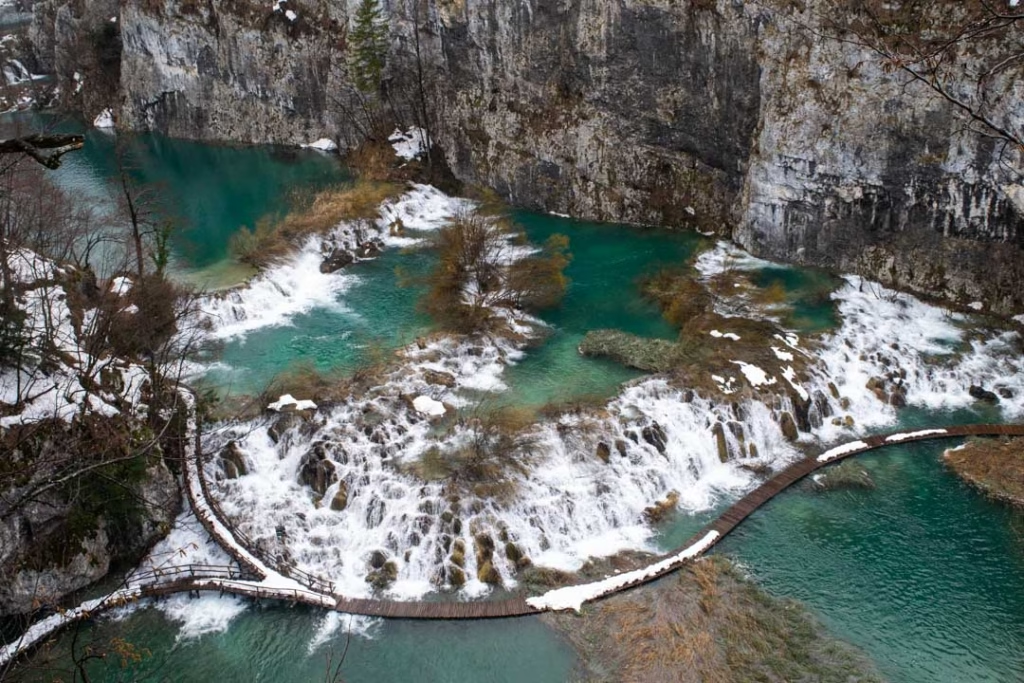
Plitvice’s winter appeal comes from its lake-and-waterfall landscape, sometimes framed by snow or ice formations. Snowfall and freezing vary, so treat them as a possibility rather than the reason a particular travel date will succeed.
The most important restriction is the division between the Lower and Upper Lakes. The Lower Lakes are usually open in winter, while the Upper Lakes are generally closed. Severe conditions can cause further restrictions, including changes to the routes available around the Lower Lakes.
Choose the Open Route Before Choosing the Entrance
Entrance 1 is associated with access to the Lower Lakes, but the correct starting point depends on the park’s current instructions. Check the park’s current hours and transport schedules before buying a ticket or setting out, including the available entrance, walking programme and any operating boats or panoramic vehicles.
Avoid building the day around a summer route letter or assuming you can link both lake systems. A winter visit may cover a smaller area, and transport services can change with the weather. Stay on the authorised route even when another boardwalk looks reachable.
Allow a substantial part of the daylight period for the visit and travel. An overnight stay nearby gives more flexibility if poor road conditions make an early departure from a distant city impractical. Inside the park, expect reduced catering options and bring something to eat and drink.
Krka National Park in Winter
Krka makes sense for travellers already staying in central Dalmatia who want a waterfall day without planning a mountain excursion. Skradinski buk is the clearest focus for a first visit, with a walking circuit through the waterfall landscape and the nearby historic watermill area.
The park describes its winter landscape in terms of abundant water and more visible rock and tufa formations. Tufa is the limestone deposit that forms the river’s natural barriers. The experience centres on flowing water and the river landscape; snow should not be the expectation here.
Use Lozovac as the Starting Point for Planning
Lozovac is Krka’s main road entrance. Under the park’s published winter arrangements, visitors may enter by car, replacing the seasonal park-bus approach used during the warmer part of the year. Follow staff directions for the permitted road access and parking on arrival.
The Skradinski buk circuit is approximately 1.9 km long, with wooden walkways and steps. That distance describes the circuit itself; it does not automatically include your approach from an entrance or parking area. Wet surfaces can make progress slower than expected.
In winter, the boat transfer from Skradin and park boat excursions are suspended. Use Lozovac if you’re driving. From Skradin, check whether the 3.4 km walking trail from Skradin Bridge to Skradinski buk is open before setting out.
Reserve roughly half a day for a focused Skradinski buk visit, allowing extra time for travel and any additional site confirmed open. Swimming at Skradinski buk is prohibited throughout the year.
Paklenica for Winter Canyon Walks
Paklenica sits where the Velebit mountain landscape meets the coast near Starigrad-Paklenica. Its canyons give walkers a different experience from the lake circuits at Plitvice and Krka, but proximity to the sea does not remove winter mountain hazards.
For a first visit, ask about conditions in the lower Velika Paklenica canyon, approached through Entrance 1. Choose an out-and-back walk with a clear turnaround point, accounting for the climbing, uneven stone and available daylight. The route continues uphill into much more demanding terrain, so reaching the canyon does not commit you to a mountain-hut or summit walk.
Strong bura winds can make an outing unsuitable, and snow or ice may affect higher sections. Postpone the walk when the forecast or park advice is unfavourable. A calm waterfront in a nearby town is not enough evidence that the intended mountain route is suitable.
Manita peć cave is a guided attraction with a seasonal opening schedule. Its published regular visiting season excludes winter, so leave it out of a winter itinerary unless the park confirms a specific visit. Plan the outing around the canyon rather than an assumed cave tour.
Risnjak for Forest Walks and Snowshoeing
Risnjak, in Gorski Kotar, suits travellers interested in a forest setting and prepared for inland winter conditions. The distinction between its educational walks and summit routes matters more than choosing the most impressive viewpoint.
The Leska educational trail starts near the park administration at Crni Lug. This circular route is approximately 4.2 km long and has little elevation change, making it a more practical first enquiry than an ascent of Veliki Risnjak or Snježnik. Its information panels introduce the forest, karst features and local wildlife.
The park promotes snowshoeing on Leska during suitable snowy conditions. Ask about the trail and current equipment availability before travelling, because a generally accessible educational path can still be affected by fresh snow or ice.
The summit routes require a separate assessment of winter experience, equipment and weather. Choose them only with the skills and preparation the conditions demand. Risnjak is home to lynx, wolves and bears, but a normal forest walk should not be presented as a reliable way to see these elusive animals.
Northern Velebit Requires a Different Winter Plan
Northern Velebit should not be grouped with straightforward winter sightseeing parks. Its normal visitor season depends on snow cover and falls outside the main winter period. Snow can prevent road access and obscure hiking trails and their markings.
The Premužić Trail is a celebrated mountain route, but its relatively gentle construction does not make it an easy winter walk. Snow and ice change the demands of the route, and access to its starting points can be a problem before the hike even begins.
For most visitors taking a general winter holiday, save the high trails for the normal visiting season. Anyone considering a winter mountain trip should contact the park about current conditions and arrange suitable local expertise where needed. An old route description or summer map cannot establish winter accessibility.
Island Parks in Winter
Croatia’s three island national parks need their own transport checks. They are alternatives for a trip already centred on the relevant coast or island, rather than interchangeable additions to a mainland parks itinerary.
Brijuni
Brijuni is reached by park boat from Fažana, near Pula. The official timetable includes winter services, but a scheduled crossing and a bookable visitor programme are different things. Confirm the excursion or visit available on your date, its departure and the return boat before travelling to Fažana.
For an Istrian winter break, Brijuni can be worth investigating alongside a mainland alternative for poor sailing weather. Choose the visit for its island landscape and heritage, with activities determined by the programme operating that day.
Mljet
Mljet’s park occupies the island’s western part around its two saltwater lakes. Winter visits need direct arrangement: the park’s access information requires prior appointment outside its main visitor season. Obtain confirmation before booking transport or accommodation around the visit.
Also confirm which services are included, especially any boat to St Mary’s islet. Reaching Mljet does not automatically provide a connection to the national park or guarantee that the usual visitor services are running. Check the island transfer and return sailing separately.
Kornati
Kornati is a marine archipelago visited by boat, making the actual sailing arrangement central to the trip. Organised day visits are provided by authorised excursion operators; a park ticket alone does not provide transport.
Treat a winter visit as an individually confirmed boat excursion. Secure the operator, departure port and weather arrangements before including it in an itinerary. For travellers wanting a simple nature day with fewer transport dependencies, a mainland park is the more practical starting point.
Where to Stay for Winter Park Visits
Choose accommodation around the park you most want to visit and how much driving you are comfortable doing in winter. A base close to one entrance can be more useful than a property advertised as convenient for several widely separated parks.
For Plitvice, look around Jezerce, Mukinje or nearby entrance-area accommodation. Confirm how you will reach the entrance currently in use, rather than relying on a map’s straight-line distance. Rakovica and Korenica are alternatives for travellers with a car who also want to explore the surrounding area.
For Krka, Šibenik offers a city base with a separate park day, while Skradin suits travellers who prefer a smaller settlement beside the river. Staying in Skradin does not guarantee winter boat access to Skradinski buk, so establish the park approach before booking around it.
For Paklenica, Starigrad-Paklenica is convenient for focusing on canyon walks. Zadar suits a broader city break with a weather-dependent excursion. For Risnjak, consider Crni Lug for proximity to Leska or Delnice for a base in the wider Gorski Kotar area.
Prioritise confirmed heating, parking where needed, and a clear meal plan. Ask which nearby restaurants or the property’s own food services will be operating during your stay.
Transport Tickets and Winter Preparation
A car gives flexibility for mainland park visits, particularly when access arrangements change or your accommodation is outside a town. Check HAK road information before travelling through Lika, Gorski Kotar or the Velebit area, and ensure the vehicle meets the winter-equipment requirements for your route.
For a visit by bus, check both outward and return services for the actual date. Confirm the stop’s location relative to the open entrance and leave enough time to finish the walk before returning to it. A summer day-trip description is insufficient for arranging a winter connection.
Buy tickets for the park and access option you will actually use. Prices and opening hours vary by season, while boat excursions, guided attractions and other services may require separate arrangements. Check the current official notice before paying for transport to a park.
For an ordinary park walk, pack waterproof footwear with reliable grip, warm layers, a windproof and waterproof outer layer, gloves, food and water. Carry a charged phone, an offline map and a headtorch, and aim to finish well before dark. Equipment and clothing do not make a closed route suitable to enter.
Higher mountain terrain requires additional skills and equipment selected for the conditions. When ice, deep snow or strong winds exceed your experience, change the outing. With children or anyone who has difficulty on steps and slippery surfaces, ask the park about a specific short route before committing to the visit.
Frequently Asked Questions
Can you visit without joining a guided tour?
Independent visits are possible at parks such as Plitvice and Krka using the routes open to visitors. Island programmes, guided attractions and winter mountain trips have different arrangements, so confirm the requirements for the actual experience you want.
Are winter park visits suitable for pushchairs?
Do not assume so. Steps, narrow boardwalks, uneven ground and ice can make a route impractical even when the park is open. Ask about the exact accessible section and its current condition.
Conclusion
For a first winter visit, start with the park closest to your holiday base and the route you can comfortably complete in the conditions. Choose Plitvice when its restricted lake circuit meets your expectations, or Krka for a waterfall day during a Dalmatian stay. Keep mountain and island plans flexible enough to change when access or weather requires it.
Disclosure: This page may contain affiliate links. This means that we get a small commission from any purchase you make, at no additional cost to you!